Cyclic sighing, the physiological sigh
- Family
- Slow and calming
- Breaths
- 6 a minute
- Carbon dioxide
- Steady
- How well tested
- Moderate
- Risk
- Low
- Timer
- Run it on this page
On this page
Cyclic sighing is a sigh done on purpose, over and over. You breathe in through your nose, sip in a little more air on top, and let it all out slowly through your mouth. Five minutes a day lifted mood more than meditation in a month-long Stanford trial, and it’s the pattern we’d start almost anyone on.
The name “physiological sigh” makes it sound like something invented in a lab or on a podcast. Your body has been doing it all day. On average a person sighs every five minutes, about 12 times an hour, each one a double breath in and a long breath out. The new part is doing it on purpose for five minutes straight, which is what the trial tested.
Our take
Make this your main practice, five minutes a day, sitting or lying down, for four weeks. It has the best result of any calming pattern in a head-to-head trial, and it’s the easiest one to keep, since your body already knows the shape. On top of that, use one or two sighs on their own whenever you notice you’re wound up.
What it is and where it comes from
In 1919 the physiologist John Scott Haldane and two colleagues described how the number of sighs changed when people moved from sitting to lying down. Composers got there first, though. Bach wrote “my sighs, my tears” into one of his cantatas.
The big discovery came in 2016. A team at UCLA and Stanford, led by Jack Feldman and Mark Krasnow, found about 200 brainstem cells that control sighing in mice. When they blocked both of the chemical signals involved, the mice stopped sighing completely. Feldman described a sigh as a normal breath with “a second breath on top of it” before you breathe out.
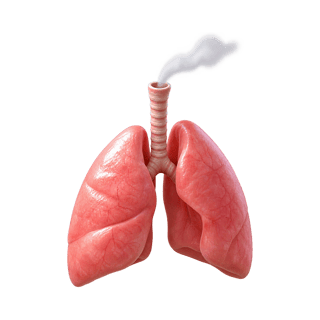
That second breath has a job. Your lungs hold about half a billion tiny air sacs, and sighs keep them from slowly collapsing. Mice engineered so they can’t sigh eventually die of lung problems.
Andrew Huberman, a Stanford neuroscientist, made the name “physiological sigh” famous as a stress tool. Then he and his Stanford colleague David Spiegel tested five minutes of it a day, which their 2023 paper calls cyclic sighing.
How to do it
- Sit or lie down. Set a timer for five minutes.
- Breathe in through your nose. Stop when your lungs feel nearly full.
- Sip in a little more. Without breathing out, take a second, shorter breath through your nose to top up.
- Let it all out slowly through your mouth. Keep going until you feel empty. The breath out should take longer than both breaths in together.
- Repeat until the timer ends. If breathing out through your mouth feels odd, use your nose. The trial allowed it.
The timer below paces it at 3 seconds in, a 1 second sip and 6 seconds out, which is six breaths a minute. People in the trial set their own pace, so slow down if our counts feel rushed.
A simple way to picture it
A new party balloon is stiff, and the first puff takes real effort. Once it’s been stretched full one time, it fills easily. Your lungs behave in a similar way. Ordinary shallow breaths let some of those tiny air sacs sag shut, and the extra sip of a sigh stretches them back open.
What happens in your body
The double breath in comes from two quick bursts of your breathing muscles, one stacked on the other. Sighs reopen collapsed air sacs and help the lungs stretch easily again, which is why your body does them on its own every few minutes. Whether the extra air raises your blood oxygen is a different question, and oxygen.guide covers it.
The calming comes from the out-breath. Your heart speeds up a little every time you breathe in and slows every time you breathe out. In a sigh the out-breath is the long part, so more of each breath goes to slowing down. The Stanford team points to exactly these two differences, the long exhale and the deeper double inhale. Why does slow breathing calm your heart? has the long version, and the brainstem covers the cells that run your breathing.
What the evidence shows
The main test ran at Stanford from June to September 2020, fully remote during the pandemic. Researchers split 108 adults into four groups for 28 days, five minutes a day. Thirty did cyclic sighing, and the others did box breathing, fast rounds or mindfulness meditation. Everyone rated their mood before and after each session.
Cyclic sighing was the only group whose good mood rose more than the meditation group’s. The gain grew the more days people kept at it, and their breathing rate fell more than in any other group. Anxiety fell in every group by about the same amount. HRV, resting heart rate and sleep didn’t change with breathwork or meditation. The groups were small, the study wasn’t registered in advance, and the authors call it exploratory.
Smaller studies since then point the same way.
| Study | Who | What they did | What happened |
|---|---|---|---|
| Germany, 2026 | 47 students | One minute of cyclic sighing, box breathing or nothing, in a stressful moment of daily life | Both breathing groups felt less anxious five minutes later |
| Netherlands, 2026 | 84 language students | Three 5-minute sessions a day for 10 days, or study as usual | Less anxiety around study times |
| Florida, 2025 | Orthopedic clinic patients | Four minutes in the x-ray waiting room, or advice on managing their injury | Less pain while they waited, same anxiety |
| US, 2026 | 62 cadets | Cyclic sighing, box breathing or normal breathing after a maximal fitness test | Both patterns brought back the heart’s calming rhythm faster |
All four are small, and the people in them knew they were doing a breathing exercise. We couldn’t find a trial longer than a month, or one that tested it against a fake breathing exercise.
Who should skip it
Very few people need to. If you feel lightheaded or your fingers tingle, you’re taking in more air than you need. Make the sips smaller and the breath out slower, the same fix a 2020 guide for clinicians gives for overbreathing during slow breathing.
Fast breathing that comes on by itself is a different thing. MedlinePlus says rapid breathing for the first time may need the emergency room, and fast breathing that keeps going or gets worse with home care needs a doctor.
12 sources
- Balban and others, Brief structured respiration practices enhance mood and reduce physiological arousal, Cell Reports Medicine, 2023pmc.ncbi.nlm.nih.gov
- Li and others, The peptidergic control circuit for sighing, Nature, 2016pmc.ncbi.nlm.nih.gov
- UCLA Newsroom, UCLA and Stanford researchers pinpoint origin of sighing reflex in the brain, 2016-02-08newsroom.ucla.edu
- Ramirez, The integrative role of the sigh in psychology, physiology, pathology, and neurobiology, Progress in Brain Research, 2014pmc.ncbi.nlm.nih.gov
- Lomas, What is the physiological sigh and how to do it, Oura blog, 2024-02-23ouraring.com
- Leggett, 'Cyclic sighing' can help breathe away anxiety, Stanford Medicine News Center, 2023-02-09med.stanford.edu
- Riedl and others, Simply breathing anxiety away? One-minute cyclic sighing versus box breathing for acute anxiety in real life, Anxiety, Stress and Coping, 2026pubmed.ncbi.nlm.nih.gov
- Wang and others, Learning proximal cyclic sighing buffers anxiety across learning moments and boredom across days, NPJ Science of Learning, 2026pubmed.ncbi.nlm.nih.gov
- Hanley and others, Cyclic sighing in the clinic waiting room may decrease pain: results from a pilot randomized controlled trial, Journal of Behavioral Medicine, 2025pubmed.ncbi.nlm.nih.gov
- Jones and others, Effectiveness of structured breathwork interventions on heart rate variability and heart rate recovery following maximal exertion in tactical athletes, Medicine and Science in Sports and Exercise, 2026pubmed.ncbi.nlm.nih.gov
- Shaffer and Meehan, A practical guide to resonance frequency assessment for heart rate variability biofeedback, Frontiers in Neuroscience, 2020pmc.ncbi.nlm.nih.gov
- MedlinePlus, Hyperventilation, reviewed 2026-07-22medlineplus.gov