Belly breathing: how to breathe with your diaphragm
- Family
- Slow and calming
- Breaths
- No set pace
- Carbon dioxide
- Steady
- How well tested
- Weak
- Risk
- Low
- Timer
- Run it on this page
On this page
Belly breathing means letting your diaphragm do the work, so your belly rises when you breathe in and your chest barely moves. It’s how the Cleveland Clinic and the American Lung Association teach slow breathing. The trials of it on its own are small and hard to compare. We’d learn it once, with a hand on your belly, then use it inside whatever slow pattern you like.
Belly breathing gets talked about as a technique with powers of its own. The Cleveland Clinic’s page lists higher blood oxygen, lower blood pressure and a lower heart rate among its benefits. It’s easy to believe, since slow belly breaths feel so different from the way you usually breathe.
In the trials, though, belly breathing ran at 2 to 10 breaths a minute, so it was slow breathing too. That makes it hard to tell the belly from the pace. And a healthy person’s blood oxygen is already close to full. In one lab test of healthy young adults, it started at about 98.4 percent, and slow breathing raised it to about 98.9. Deep breaths will raise your blood oxygen on oxygen.guide covers that one.
Our take
Belly breathing is a skill you learn once. Spend a few days with one hand on your chest and one on your belly, until the belly hand does the moving. Then use it inside a slow pattern with a long breath out. If you have COPD or asthma, learn it alongside pursed-lip breathing.
What it is and where it comes from
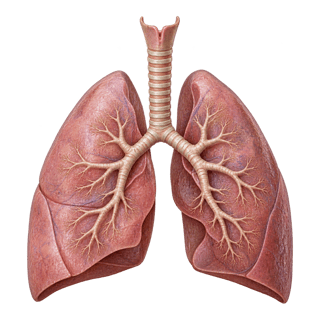
Your diaphragm is a large, dome-shaped muscle at the bottom of your lungs, and the Cleveland Clinic calls it the most efficient breathing muscle you have. When it pulls down, your lungs fill and your belly moves out to make room.
It became a hospital exercise because of lung disease. The American Lung Association explains that with asthma, and especially COPD, the lungs lose their springiness and stale air gets trapped. The Cleveland Clinic adds that the trapped air pushes the diaphragm down and flattens it, so it works less well. Belly breathing is taught to get it moving again.
How to do it
- Lie on your back. Bend your knees and support your head.
- One hand on your upper chest, one just below your ribs.
- Breathe in slowly through your nose. Let your belly push your lower hand up, and keep the chest hand as still as you can.
- Breathe out through pursed lips. Tighten your belly a little and feel your lower hand sink.
- Five to 10 minutes, three or four times a day. The Cleveland Clinic gives this starting dose, and these steps come from its page. Once it’s easy, do it sitting up.
- Make the breath out longer. The American Lung Association says to breathe out for two to three times as long as you breathe in.
The timer below runs 3 seconds in and 7 out. Let your belly rise on every breath in and fall on every breath out.
A simple way to picture it
Your diaphragm works like the plunger in a syringe. Pull it down and air rushes in to fill the space. Your belly moving out is the sign that the plunger is doing the pulling, instead of your chest and shoulders.
What happens in your body
When you breathe out, your belly muscles help push the air back out. In a 2017 Beijing study, breathing dropped from about 17 breaths a minute to about 4. Your heart slows a little on every breath out, so slower breathing gives it more time to slow. Why does slow breathing calm your heart? explains it.
The surprising part is lower down. Your diaphragm wraps around the bottom of your esophagus, where it meets your stomach, and it’s part of the valve that keeps stomach acid down. Doctors in Graz, Austria, guessed that training the diaphragm might tighten that valve.
What the evidence shows
In Graz in 2012, the doctors split 19 people with reflux at random. Ten did belly breathing training for four weeks and nine didn’t. In the training group, the share of the day with acid in the esophagus fell from 9.1 percent to 4.7 percent, while the other group didn’t change. After nine months, the people who kept practicing were taking a lot less acid medicine. It was only 19 people, but the acid was measured with a probe.
In that Beijing study, 40 office workers at a tech company were split into two groups. One did 20 sessions of belly breathing over eight weeks, 15 minutes each, with a coach. The other did nothing. The breathing group’s bad moods eased, their attention scores went up and their cortisol, a stress hormone, fell. People were assigned by the order they signed up, and doing nothing is an easy group to beat.
| Study | Who | What happened |
|---|---|---|
| Graz, Austria, 2012 | 19 people with reflux, four weeks | Time with acid in the esophagus fell by about half |
| Beijing, 2017 | 40 office workers, eight weeks | Better mood and attention and lower cortisol, against a group that did nothing |
| Review, 2024 | 73 trials in serious lung disease, 5,479 people | Belly or pursed-lip breathing eased breathlessness a little, less than patients notice. Quality of life improved |
| Review, 2026 | 48 trials | Consistent help for reflux, anxiety, symptoms after COVID-19 and diabetes in pregnancy. Mixed results in COPD |
A 2019 review found only three studies of belly breathing for stress, all small. The 2026 review is the widest look so far. Sessions ran from 3 to 45 minutes, so belly breathing meant very different things, and only about 2 percent of the results had a low risk of bias. We couldn’t find a trial that compared belly breathing with chest breathing at the same slow pace. Nobody knows how much of the effect is the belly and how much is the pace.
Who should skip it
Very few people need to skip it.
- Lightheaded. Breathe smaller. Breathing more air than you need, even slowly, lowers the carbon dioxide in your blood, and MedlinePlus lists lightheadedness as the result. Why do I feel dizzy after breathing exercises?
- COPD or asthma. The Cleveland Clinic says it shouldn’t be your only treatment, and to check with your provider first.
- Recovering from heart surgery. In the 2026 review it did worse than standard care after heart surgery, so follow your rehab team’s plan.
- Chest pain or shortness of breath at rest. See a doctor. MedlinePlus lists both as reasons to see your provider.
10 sources
- Cleveland Clinic, Diaphragmatic breathing, updated 2022-03-30my.clevelandclinic.org
- American Lung Association, Breathing exercises for better lung health, updated 2026-06-22lung.org
- Ma X and others, The effect of diaphragmatic breathing on attention, negative affect and stress in healthy adults, Frontiers in Psychology, 2017pmc.ncbi.nlm.nih.gov
- Eherer AJ and others, Positive effect of abdominal breathing exercise on gastroesophageal reflux disease: a randomized, controlled study, American Journal of Gastroenterology, 2012pubmed.ncbi.nlm.nih.gov
- Hopper SI, Murray SL, Ferrara LR and Singleton JK, Effectiveness of diaphragmatic breathing for reducing physiological and psychological stress in adults: a quantitative systematic review, JBI Database of Systematic Reviews and Implementation Reports, 2019pubmed.ncbi.nlm.nih.gov
- Burge AT and others, Breathing techniques to reduce symptoms in people with serious respiratory illness: a systematic review, European Respiratory Review, 2024pmc.ncbi.nlm.nih.gov
- Kwon CY, Won J and Lee B, The health effects of diaphragmatic breathing: a systematic review, Complementary Therapies in Medicine, 2026pubmed.ncbi.nlm.nih.gov
- Mason H and others, Cardiovascular and respiratory effect of yogic slow breathing in the yoga beginner: what is the best approach?, Evidence-Based Complementary and Alternative Medicine, 2013pmc.ncbi.nlm.nih.gov
- MedlinePlus, Hyperventilation, reviewed 2026-07-22medlineplus.gov
- MedlinePlus, Breathing difficulty, reviewed 2025-04-01medlineplus.gov