Where does your breathing rhythm come from?
On this page
- Where in the brain does the rhythm start?
- How many cells does it take?
- Where do sighs come from?
- Can these cells change how calm you feel?
- Why can you take the controls?
- Why can’t you hold your breath until you pass out?
- A simple way to picture it
- What happens when the automatic part is missing?
- Where the explanation stops
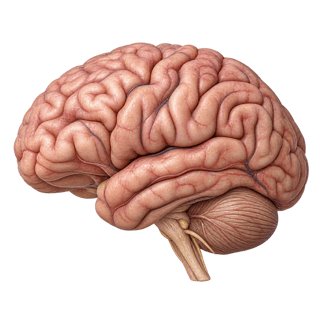
Your breathing rhythm comes from a small cluster of nerve cells low in the brainstem called the preBötzinger complex, found in newborn rats in 1991. It fires every breath from birth, about 700 an hour at rest, and a circuit next door turns about 12 of those into sighs. You can take the controls for a while, but you can’t switch it off.
Most people think of breathing as something the lungs do, the way the heart beats by itself. But lungs can’t move on their own. The diaphragm and chest muscles pull them open, and those muscles only work when nerves tell them to. Without signals from the brainstem, the spinal cord can’t organize breathing at all. The other common belief is the opposite one, that breathing is yours to run because you can hold it. You can hold your chest still, but the rhythm underneath keeps going the whole time.
What it means for you
You can’t break your breathing by doing an exercise wrong. Whatever pattern you follow, the rhythm generator keeps running underneath and takes back over when you stop steering. Slow breathing works with this system, since you’re guiding a rhythm your brainstem already keeps. The main way people get around the backstop is to breathe hard first and then hold, which is why holds after fast breathing stay on dry land, sitting or lying down, never in water or the car.
Where in the brain does the rhythm start?
In 1991 nobody knew exactly which cells made the rhythm of breathing. Jeffrey Smith and Jack Feldman at UCLA, working with Klaus Ballanyi and Diethelm Richter from the University of Göttingen in Germany, went looking. They kept the brainstems of newborn rats alive in a dish, where the nerves still fired in a breathing rhythm. Then they sliced away thin sections, one at a time, from either end.
The rhythm kept going cut after cut, until they reached one small region of the lower brainstem. Removing just that region stopped it. A slice more than half a millimeter thick that held the region kept making the rhythm on its own, at 40 to 70 percent of the whole brainstem’s speed. They named it the pre-Bötzinger complex and published the finding in Science.
Later work in grown rats showed it runs breathing after infancy too. Killing some of its cells over several days led to severe breathing problems. Silencing one type of its cells in awake rats stopped breathing within minutes, until a ventilator took over.
How many cells does it take?
In rodents, the core of the preBötzinger complex is about 1,000 nerve cells, according to a 2018 review by Christopher Del Negro, Gregory Funk and Jack Feldman. The smaller groups that sense carbon dioxide, start sighs or link breathing to alertness each have between 200 and 800.
How few cells run breathing, counted in rats and mice
Where do sighs come from?
Every few minutes you take a breath about twice the normal size without noticing. Del Negro and his coauthors worked out that in the hour or so it takes to get through their review, a reader takes about 700 normal breaths and about 12 sighs. People sigh when they’re sad, relieved or tired, but sighs also have a mechanical job. They reopen the tiny air sacs in the lungs, the alveoli. Feldman told UCLA in 2016 that without a sigh every five minutes or so, “the alveoli will slowly collapse, causing lung failure.”
An hour of resting breathing
That same year, Li, Yackle and colleagues in Mark Krasnow’s lab at Stanford and Feldman’s lab at UCLA found the circuit in rodents. Small groups of cells in the brainstem area that senses carbon dioxide make two small proteins, neuromedin B and gastrin-releasing peptide. About 200 cells in the preBötzinger complex carry receptors for them. Adding either protein to those cells brought on sighs, and blocking both receptors stopped sighing. Killing the receptor cells cut sighing by about 95 percent within five days, while the rest of breathing looked normal at first.
Can these cells change how calm you feel?
A year later, Yackle and colleagues found about 175 cells on each side of the mouse preBötzinger complex, out of roughly 3,000. They connect straight to the locus coeruleus, a brain center tied to attention, arousal and panic. The team removed those cells in adult mice. The mice kept breathing normally, with a shift toward slower breaths. But they groomed about three times as much, spent less time exploring (62 percent of the time against 87), and spent less time in an aroused brain state.
It was mice, and nobody knows yet whether people have the same circuit. The authors wrote that if it exists in humans it could be a target for treatment. It fits an old observation they opened their paper with, that slow, controlled breathing has been used for centuries to calm the mind. Why does slow breathing calm your heart? covers the side of it that has been measured in people.
Why can you take the controls?
Breathing also takes orders from the parts of the brain you use on purpose, for talking, singing or blowing out candles. Several areas of the cortex send connections down to the preBötzinger complex, though there aren’t many of them. A 2023 review by Krohn and colleagues noted that most breathing control stays subconscious even while you’re breathing on purpose.
Holding your breath doesn’t stop the rhythm either. Parkes, a physiologist at the University of Birmingham, reviewed the research in 2006 and found that the brain’s breathing rhythm keeps running through a hold. You hold your chest still on top of it, possibly with some help from a steady squeeze of the diaphragm.
Why can’t you hold your breath until you pass out?
Healthy people on dry land don’t seem able to hold their breath until they pass out, Parkes found. A powerful reflex overrides the hold and forces the breath that ends it, called the breakpoint. Lung size, blood gases and the oxygen sensors in the neck don’t explain it on their own, and signals from the diaphragm may play a bigger part than once thought. The exception is a hold after fast breathing, which delays the reflex while oxygen keeps falling. What happens when you hold your breath? follows a hold from start to finish.
A simple way to picture it
Think of a band whose drummer never stops. The singer can wave the band quiet for a few bars, and everyone holds still, but the drummer keeps counting under the silence. When the singer’s done, the band comes back in on the beat. Every few minutes the drummer throws in a big fill, the way your brainstem throws in a sigh.
What happens when the automatic part is missing?
A rare genetic condition shows what breathing looks like without its automatic drive. Congenital central hypoventilation syndrome was first reported in a newborn in 1970, under the name Ondine’s curse. It comes from changes in one gene, PHOX2B, which turn up in 90 percent of patients, and it shows up in about 1 in 148,000 to 200,000 births. More than 1,000 people with it have been identified.
People with it breathe too shallowly, especially asleep, and it’s worst in non-REM sleep. Their breathing barely responds to rising carbon dioxide, awake or asleep, and they don’t feel short of breath even as carbon dioxide climbs and oxygen falls. Babies with it often need a ventilator around the clock. As they grow, some learn to breathe well enough while awake to come off it during the day and use it only for sleep. Some use a pacemaker that drives the diaphragm.
In mice given the same gene change, the carbon dioxide sensing cells never formed, and the pups died at birth when they couldn’t breathe. Whether people with the condition lack the same cells hasn’t been confirmed. The 2020 management guidelines strongly discourage free diving and say swimming needs close watching, with limited time underwater.
Where the explanation stops
Nobody knows exactly how the preBötzinger cells make the beat. Del Negro, Funk and Feldman describe the core as linked circuits that drive each breath in, and the cell-by-cell details are still being worked out. The calm cells and the sigh circuit were found in rodents, and nobody knows yet whether people have the same circuits. Parkes wrote in 2006 that no simple explanation fit all the evidence on what ends a breath hold.
11 sources
- Smith, Ellenberger, Ballanyi, Richter and Feldman, Pre-Bötzinger complex: a brainstem region that may generate respiratory rhythm in mammals, Science, 1991pmc.ncbi.nlm.nih.gov
- Del Negro, Funk and Feldman, Breathing matters, Nature Reviews Neuroscience, 2018pmc.ncbi.nlm.nih.gov
- Li and others, The peptidergic control circuit for sighing, Nature, 2016pmc.ncbi.nlm.nih.gov
- UCLA Health, UCLA and Stanford researchers pinpoint origin of sighing reflex in the brain, 2016-02-08uclahealth.org
- Yackle and others, Breathing control center neurons that promote arousal in mice, Science, 2017pmc.ncbi.nlm.nih.gov
- Guyenet and Bayliss, Neural control of breathing and CO2 homeostasis, Neuron, 2015pmc.ncbi.nlm.nih.gov
- Krohn and others, The integrated brain network that controls respiration, eLife, 2023pmc.ncbi.nlm.nih.gov
- Parkes, Breath-holding and its breakpoint, Experimental Physiology, 2006pubmed.ncbi.nlm.nih.gov
- Trang and others, Guidelines for diagnosis and management of congenital central hypoventilation syndrome, Orphanet Journal of Rare Diseases, 2020pmc.ncbi.nlm.nih.gov
- MedlinePlus Genetics, Congenital central hypoventilation syndrome, updated 2019-09-01medlineplus.gov
- Bishara, Keens and Perez, The genetics of congenital central hypoventilation syndrome: clinical implications, The Application of Clinical Genetics, 2018pmc.ncbi.nlm.nih.gov