Why does slow breathing calm your heart?
On this page
Your heart speeds up a little on every breath in and slows on every breath out. Breathe slowly and each swing gets bigger, and near six breaths a minute it peaks. A long, slow out-breath gives your heart’s brake more time to work, which is why every calming pattern stretches the exhale.
People usually explain slow breathing as “relaxing” or “getting more oxygen,” and neither tells you much. The real reason is mechanical. Your heart rate is tied to your breathing through a nerve that works like a brake, and slow breathing lets you work that brake on purpose. It’s also why a breathing app can show your heart rate swinging up and down during a session, and why that swing doesn’t mean your resting numbers will change.
What we’d do
Breathe at five to six breaths a minute, with the out-breath at least as long as the in-breath, for five minutes a day. Cyclic sighing and six a minute both land there. Don’t spend money or time hunting for your exact resonance rate. In a 2026 trial a plain six a minute did just as well.
If you remember three things
- Breathing in lets off your heart’s brake, breathing out presses it. That’s built in, and you can feel it on your pulse.
- Slow breathing makes the swing much bigger. Near six breaths a minute it can grow 4 to 10 times bigger than at rest.
- Calmer comes faster than a higher resting HRV. In a four-week trial, stress fell and resting HRV stayed where it was.
What does the rosary have to do with it?
In 2001, a team of doctors in Pavia and Florence in Italy, led by Bernardi, wired 23 healthy adults to heart and blood pressure monitors and asked them to recite the Ave Maria in Latin. Then they asked them to chant a yoga mantra.
The prayer and the mantra did the same thing. Recited at six cycles a minute, both produced what the team called “striking, powerful, and synchronous” increases in the natural rhythms of heart rate and blood pressure. Baroreflex sensitivity, a measure of how strongly heart rate answers a change in blood pressure, rose from 9.5 to 11.5 milliseconds per mmHg. The researchers concluded that rhythm formulas that involve breathing at six breaths a minute have good effects on how people feel, and possibly on their bodies.
Two very different traditions, one from Europe and one from Asia, had landed on about the same breathing pace. You don’t need to pray or chant to get it. A timer does it too.
How does the brake work?
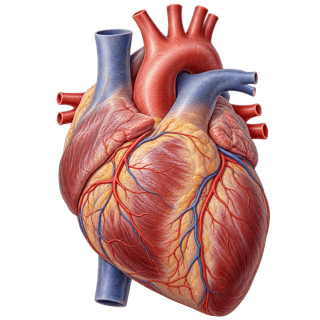
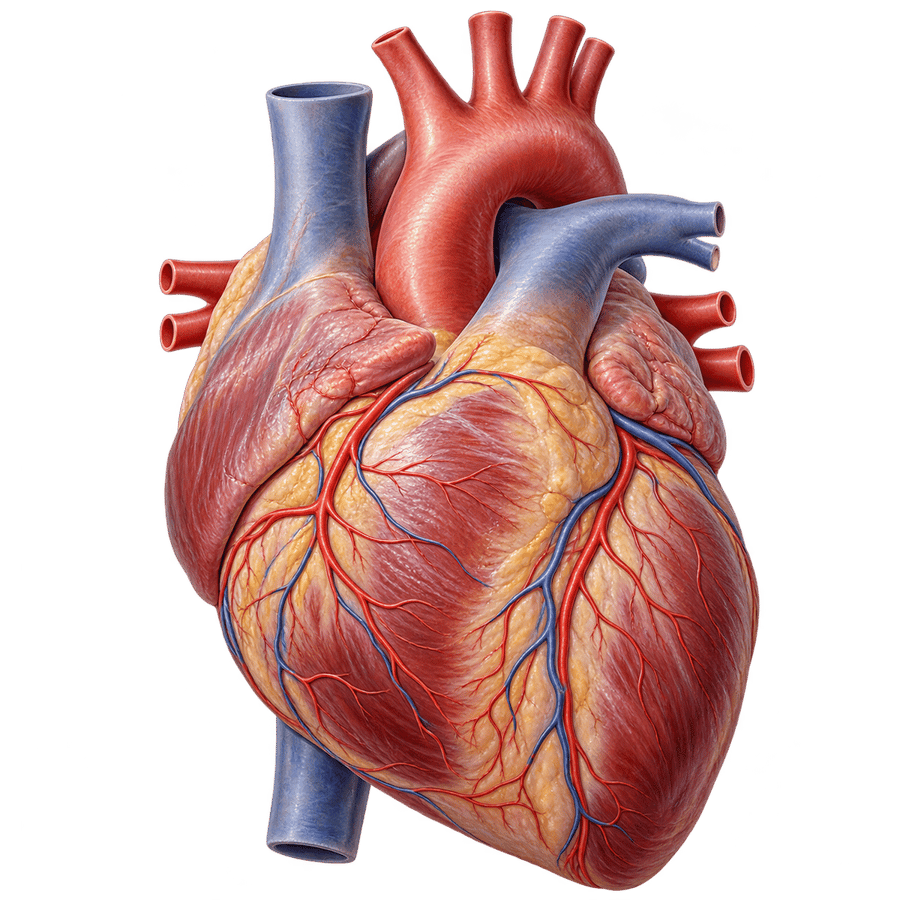
Your vagus nerve runs from your brainstem down to your heart, and when it fires, your heart slows. The heart’s control center in your brainstem is linked to your breathing. When you breathe in, it holds back the vagus nerve, and your heart speeds up. When you breathe out, it lets the vagus nerve fire again, and your heart slows.
This happens on every breath, all day, and it’s called respiratory sinus arrhythmia. It’s a sign of a healthy heart. At normal breathing speed the swing is small, since each breath is over in a few seconds. Slow your breathing and each phase lasts long enough for the heart to speed up further and slow down further.
Why six breaths a minute?
There’s a second loop involved. When your heart speeds up on a breath in, your blood pressure rises about five seconds later. Pressure sensors in your arteries notice and slow the heart back down. When you breathe at about six breaths a minute, five seconds in and five seconds out, these two loops fall into step. The breath and the pressure reflex push the heart rate the same way at the same time.
The result is a big, smooth wave in heart rate. In biofeedback studies, breathing near this pace makes the gap between the fastest and slowest heartbeat grow 4 to 10 times bigger than at rest. Specialists call this pace your resonance frequency. In adults it sits between 4.5 and 6.5 breaths a minute, set mostly by how much blood is in your blood vessels. Children, with smaller bodies, resonate faster, at 6.5 to 9.5.
A simple way to picture it
Think of pushing a child on a swing. Push at random moments and the swing barely moves. Push each time it comes back toward you and it goes higher with every push, with no extra effort.
Your breath is the push and the blood pressure reflex is the swing. At about six breaths a minute you push in time with the swing, and the heart rate wave builds. A little faster or slower and you still get most of it, which is why the exact pace is less important than people think.
Does a longer out-breath help?
It seems to, for how you feel. In a 2014 study at KU Leuven in Belgium, 30 people breathed at either 6 or 12 breaths a minute, with either a long out-breath or a long in-breath. The out-breath was about two and a half times the in-breath in one version, and the other way round in the other. People felt more relaxed, less stressed and more energized when the out-breath was the long one. The long out-breath also boosted the breathing-linked part of HRV, but only at the slow pace.
The evidence on the heart side is mixed. A 2020 guide to resonance breathing recommends a longer out-breath than in-breath, but also cites studies that found no difference in heart rhythm between equal breaths and a 1 to 2 ratio. The 2026 Polish trial’s home pacer kept a ratio of 4 in to 6 out. Cyclic sighing’s out-breath is longer than its two sips in, and it did best in the Stanford trial. We’d make the out-breath at least as long as the in-breath, and longer if it feels good.
What changes over weeks?
Four things have been measured, and they don’t all move together.
| What | What studies found | How sure we are |
|---|---|---|
| Heart rate swing during the session | Rises during slow breathing in 172 studies pooled in 2022 | Very confident. It’s how slow breathing works |
| Stress and anxiety | Lower after four weeks against a waiting list (88 adults, 2026). Small to medium drop across 12 trials (2023) | Fairly confident |
| Your breathing rate | Fell more with breathwork than meditation over a month, most with cyclic sighing (Stanford, 2023) | Moderate, one trial |
| Resting HRV | No change in the 2026 trial or the Stanford trial. A small rise across pooled studies in 2022 | Unclear |
The 2026 trial is the clearest test. Researchers in Warsaw took 88 stressed adults aged 25 to 40 and split them three ways. One group breathed at a resonance rate measured for each person, one at a fixed six a minute, and one waited. The two breathing groups practiced 20 minutes a day at home for four weeks, with a weekly session in the lab. Stress, anxiety and depression scores fell in both breathing groups compared with the waiting list, and the two groups did about the same. Resting HRV didn’t rise in either.
Slow breathing helped people feel less stressed without moving resting HRV, at least over a month. The calm doesn’t depend on the number. Does breathwork raise my HRV? and hrv.guide’s take go into the numbers.
Where the explanation stops
The swing in heart rate is the best-understood part, but nobody has proven that the swing itself is what makes people calmer. Some of the calm may come from attention and the feeling of control, since mindfulness meditation eased anxiety about as much in the Stanford trial without changing the breath. And the trials are small, and the people in them know they’re breathing on purpose, so some of the effect may be expectation. The 2026 trial’s authors say so themselves, since their comparison group only waited.
What we’re sure of is the mechanism in the moment. Slow your breathing and your heart follows within a breath or two.
Try it
Run six a minute on the timer for five minutes, or cyclic sighing, which lands at the same pace. If you’re curious about your own resonance, the resonance finder runs a minute each at 6.5 down to 4.5 breaths a minute. Keep the one that feels easiest.
7 sources
- Bernardi and others, Effect of rosary prayer and yoga mantras on autonomic cardiovascular rhythms: comparative study, BMJ, 2001pmc.ncbi.nlm.nih.gov
- Shaffer and Meehan, A practical guide to resonance frequency assessment for heart rate variability biofeedback, Frontiers in Neuroscience, 2020pmc.ncbi.nlm.nih.gov
- Van Diest and others, Inhalation/exhalation ratio modulates the effect of slow breathing on heart rate variability and relaxation, Applied Psychophysiology and Biofeedback, 2014pubmed.ncbi.nlm.nih.gov
- Sumińska, Rynkiewicz and Szulczewski, Resonance frequency versus fixed 0.1 Hz breathing in HRV biofeedback: a four-week randomized comparison, Scientific Reports, 2026pmc.ncbi.nlm.nih.gov
- Laborde and others, Effects of voluntary slow breathing on heart rate and heart rate variability: a systematic review and a meta-analysis, Neuroscience and Biobehavioral Reviews, 2022pubmed.ncbi.nlm.nih.gov
- Balban and others, Brief structured respiration practices enhance mood and reduce physiological arousal, Cell Reports Medicine, 2023pmc.ncbi.nlm.nih.gov
- Fincham, Strauss, Montero-Marin and Cavanagh, Effect of breathwork on stress and mental health: a meta-analysis of randomised-controlled trials, Scientific Reports, 2023pmc.ncbi.nlm.nih.gov