Inspiratory muscle training: 30 hard breaths a day
- Breaths
- 30 breaths in about 5 minutes
- Carbon dioxide
- Rises
- How well tested
- Moderate
- Risk
- Low
On this page
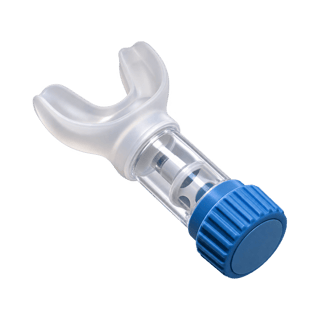
Inspiratory muscle training means breathing in hard through a small handheld trainer that pushes back against you. Done as 30 hard breaths a day, six days a week, it lowered the top blood pressure number about 9 points in six weeks. Those trials were small, and they compared it with fake training. Nobody knows yet whether the drop lasts for years. Of all the breathing practices on this site, it has the best-controlled blood pressure result.
Most people picture a breathing exercise for blood pressure as slow and calm. It makes sense, since slow breathing calms you within minutes. But when researchers pooled blinded trials of devices that pace slow breathing, the devices did no better than listening to music or using a fake device. Can breathing exercises lower blood pressure? has the details.
The breathing practice that did beat a fake version is the opposite of calm. It’s about five minutes of hard effort a day, with a kind of trainer that was mostly a tool for athletes and people with lung conditions like COPD.
Our take
If your blood pressure is above normal, a breathing trainer has the strongest evidence of any breathing practice. Add it to walking and eating less salt. We’d do 30 breaths a day, six days a week, at the resistance the trials used. Ask your doctor first if you have heart or lung disease, measure your pressure at home before and after six weeks, and never change a medicine because of it.
What it is and where it comes from
In 1976, Leith and Bradley had four young volunteers breathe in and out as hard as they could against a blocked airway. They did it 30 to 45 minutes a day, five days a week. After five weeks, the pressure they could produce had gone up about 55 percent. For decades after that, breathing muscle training meant long sessions at light resistance.
Then E. Fiona Bailey’s lab at the University of Arizona tried a few hard breaths instead. In 2015, her team trained healthy adults in five different ways for six weeks. Only the groups that made big pressure swings inside the chest saw their blood pressure fall, by about 9 points on the top number. The group that took big breaths at low pressure got nothing. In 2016 the lab tried it on people with sleep apnea. In 2021 a team at the University of Colorado Boulder ran a double-blind trial in midlife and older adults.
How to do it
The Colorado trial used this routine.
- Find your maximum. The researchers measured each person’s strongest possible breath in against a blocked tube, called maximal inspiratory pressure. Ask your doctor where you can get yours measured.
- Set the trainer. Week one at 55 percent of that maximum, week two at 65 percent, then 75 percent from week three on.
- Do 30 breaths. Five sets of six hard breaths in, with a minute’s rest between sets. It takes about five minutes.
- Six days a week, for six weeks. People in the trial finished 94 percent of their sessions.
- Sit down to train, in case you get lightheaded.
Every trial in a 2022 review taught people in person and checked their sessions daily or weekly. Nobody knows yet whether training alone at home works as well.
A simple way to picture it
It’s closer to a short set at the gym than to meditation. You do a few hard reps, rest, and do a few more, and the change comes from how hard each rep is.
What happens in your body
The Colorado trial found some clues. After six weeks, a standard test of how well the artery in the upper arm widens came out about 45 percent better. Blood serum from after training also made lab-grown blood vessel cells produce more nitric oxide, which relaxes blood vessels.
It doesn’t seem to come down to stronger muscles. In a 2022 analysis of five trials, how much stronger people’s breathing got didn’t predict how much their blood pressure fell. Systolic vs diastolic explains the top and bottom numbers.
What the evidence shows
The Colorado trial took 36 adults aged 50 to 79 whose top number was 120 or more. Half trained at 75 percent and half at 15, and neither they nor the researchers knew who was in which group. The top number fell from 135 to 126 in the training group and from 134 to 131 in the fake group. Six weeks after they stopped, the 15 trained people who came back were still at 128.
| Study | Who | What happened |
|---|---|---|
| Five trials pooled, 2022 | 67 trained and 61 fake-trained adults aged 18 to 82 | Top number down 9 and bottom down 4, starting by week two |
| Review, 2023 | 12 trials, 386 people | Top number about 8 lower and bottom about 4 lower |
| Seoul, 2025 | 28 people with high blood pressure, 8 weeks | Down about 9 points, against about 6 with 30 minutes of cardio five days a week, a difference too small to count |
These are good results, but small ones, and the 2022 analysis pooled pilot trials written up by the researchers who developed the method. The Seoul trial is a useful outside check. Its drop had faded four weeks after people stopped, while the cardio group’s held. In Colorado, most of the drop was still there six weeks after stopping.
Nobody has shown yet whether the drop lasts for years or prevents heart attacks and strokes. A six-month trial in adults with sleep apnea was registered in 2021, and we couldn’t find its results yet.
Who should skip it
Each hard breath drops the pressure inside your chest, throat, inner ears and sinuses. For that reason, a 2021 UCLA study of the trainer left out people with these conditions, and they should talk to a doctor before using one.
- A collapsed lung that happened on its own, or one from an injury that hasn’t fully healed.
- A burst eardrum or any eardrum problem, including recent ear surgery.
- Asthma that isn’t under control, or trouble sensing when you’re short of breath.
- Heart or lung disease. Ask your doctor first.
Keep taking any blood pressure medicine. People in the Colorado trial stayed on theirs, and 2 of 18 had minor side effects, a sore neck and lightheadedness. Neither quit. To check your own result, measure at home for a week before you start and again after six weeks.
A trainer is an add-on. The free moves come first, from moving most days to breathing through your nose, and how to breathe better naturally goes through them.
12 sources
- Craighead DH and others, Time-efficient inspiratory muscle strength training lowers blood pressure and improves endothelial function, NO bioavailability, and oxidative stress in midlife/older adults with above-normal blood pressure, Journal of the American Heart Association, 2021pmc.ncbi.nlm.nih.gov
- Craighead DH and others, A multi-trial, retrospective analysis of the antihypertensive effects of high-resistance, low-volume inspiratory muscle strength training, Journal of Applied Physiology, 2022pmc.ncbi.nlm.nih.gov
- Craighead DH and others, Translational potential of high-resistance inspiratory muscle strength training, Exercise and Sport Sciences Reviews, 2022pmc.ncbi.nlm.nih.gov
- Li W and others, A hypotensive protocol of inspiratory muscle strength training: systematic review and meta-analysis with trial sequential analysis, Journal of Clinical Hypertension, 2023pmc.ncbi.nlm.nih.gov
- Jae SY, Choi TG, Kim HJ and Kunutsor SK, Comparison of inspiratory muscle strength and aerobic exercise training and detraining on blood pressure in hypertensive patients, Clinical Hypertension, 2025pmc.ncbi.nlm.nih.gov
- Vranish JR and Bailey EF, Daily respiratory training with large intrathoracic pressures, but not large lung volumes, lowers blood pressure in normotensive adults, Respiratory Physiology and Neurobiology, 2015pubmed.ncbi.nlm.nih.gov
- Vranish JR and Bailey EF, Inspiratory muscle training improves sleep and mitigates cardiovascular dysfunction in obstructive sleep apnea, Sleep, 2016pmc.ncbi.nlm.nih.gov
- Leith DE and Bradley M, Ventilatory muscle strength and endurance training, Journal of Applied Physiology, 1976pubmed.ncbi.nlm.nih.gov
- Winkle MJ and Sankari A, Respiratory muscle strength training, StatPearls, 2024pubmed.ncbi.nlm.nih.gov
- Landman GW and others, Efficacy of device-guided breathing for hypertension in blinded, randomized, active-controlled trials: a meta-analysis of individual patient data, JAMA Internal Medicine, 2014pubmed.ncbi.nlm.nih.gov
- Tavoian D and others, Six months of inspiratory muscle training to lower blood pressure and improve endothelial function in middle-aged and older adults with above-normal blood pressure and obstructive sleep apnea: protocol for the CHART clinical trial, Frontiers in Cardiovascular Medicine, 2021pmc.ncbi.nlm.nih.gov
- Krause-Sorio B and others, Inspiratory muscle training for obstructive sleep apnea: protocol development and feasibility of home practice by sedentary adults, Frontiers in Physiology, 2021pmc.ncbi.nlm.nih.gov