Why does a long exhale calm you down?
Your heart speeds up a little every time you breathe in and slows every time you breathe out. A longer out-breath gives it longer on the slowing side of each breath. In a lab test at the same slow pace, people also felt more relaxed when the out-breath was the long part.
The usual advice is “take a deep breath”, which puts all the attention on the breath in. A big, fast breath in is the part that speeds your heart up. The calming happens on the way out, and the longer that part lasts, the more of each minute your heart spends slowing down.
What we’d do
Whatever pattern you use, let the out-breath be the long part. Breathe in through your nose, then breathe out slowly, for about one and a half to two times as long. Cyclic sighing and 4-7-8 are built that way already.
Your heart follows your breath
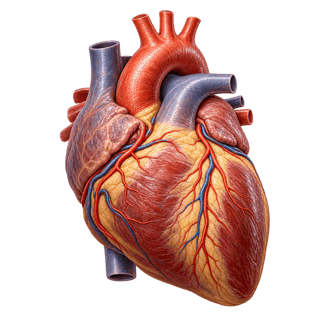
Each time you breathe in, the part of your brain that runs your heart eases off the vagus nerve, the nerve that acts as your heart’s brake, and your heart speeds up. Each time you breathe out, the brake comes back on and your heart slows. Doctors call this swing respiratory sinus arrhythmia. It’s normal and healthy, and you can feel it if you hold two fingers on your pulse and breathe slowly.
Breathing in lifts your foot off the brake. Breathing out presses it again. A long out-breath keeps your foot on the brake for longer.
The lab test
In a 2014 study in Belgium, 30 people each tried four ways of breathing for five minutes. At six breaths a minute, they did one round with a short in-breath and a long out-breath (3 seconds in, 7 out) and one round the other way around (7 in, 3 out). They also did both at 12 breaths a minute.
With the long out-breath, people said they felt more relaxed, less stressed, more mindful and more positive. The long out-breath also raised the high-frequency part of their HRV, the part that rises and falls with breathing, but only at the slow pace. Slowing down on its own mostly just made them feel more energetic.
How the patterns compare
| Pattern | In | Out | Out against in |
|---|---|---|---|
| 4-7-8 | 4 seconds | 8 seconds | Twice as long |
| Cyclic sighing (our pacing) | 3 seconds plus a 1 second sip | 6 seconds | One and a half times |
| Six a minute | 5 seconds | 5 seconds | Equal |
| Box breathing | 4 seconds | 4 seconds | Equal |
Cyclic sighing is the pattern that did best in the 2023 Stanford trial, and its authors describe it as the one that “emphasizes prolonged exhalations”. The trial couldn’t prove the long out-breath was the reason, since the patterns differed in other ways too. To see the ratio for any counts you like, put them into pattern speed.
More on the heart’s swing and why six breaths a minute makes it biggest is in why does slow breathing calm your heart.
Extended exhale has every study of the long out-breath, including the ones that found no difference.
4 sources
- Shaffer F, Meehan ZM, A practical guide to resonance frequency assessment for heart rate variability biofeedback, Frontiers in Neuroscience, 2020pmc.ncbi.nlm.nih.gov
- Van Diest I et al., Inhalation/exhalation ratio modulates the effect of slow breathing on heart rate variability and relaxation, Applied Psychophysiology and Biofeedback, 2014pubmed.ncbi.nlm.nih.gov
- Balban MY et al., Brief structured respiration practices enhance mood and reduce physiological arousal, Cell Reports Medicine, 2023pmc.ncbi.nlm.nih.gov
- Andrew Weil, 4-7-8 Breath, Andrew Weil Center for Integrative Medicine, University of Arizonaawcim.arizona.edu