Which breathing exercise helps you fall asleep?
A slow pattern with a long out-breath, for five minutes in bed with the lights off. Do 4-7-8 if holds feel fine and six breaths a minute if they don’t. People who do it for a month rate their sleep better, though rings and sleep labs show much less change.
Breathing tricks get sold as a way to fall asleep in minutes. A trick that worked that fast would show up on a sleep tracker, and so far it mostly doesn’t. What the studies do find is slower and more ordinary. A few weeks of breathing slowly before bed, and people say they sleep better.
What we’d do
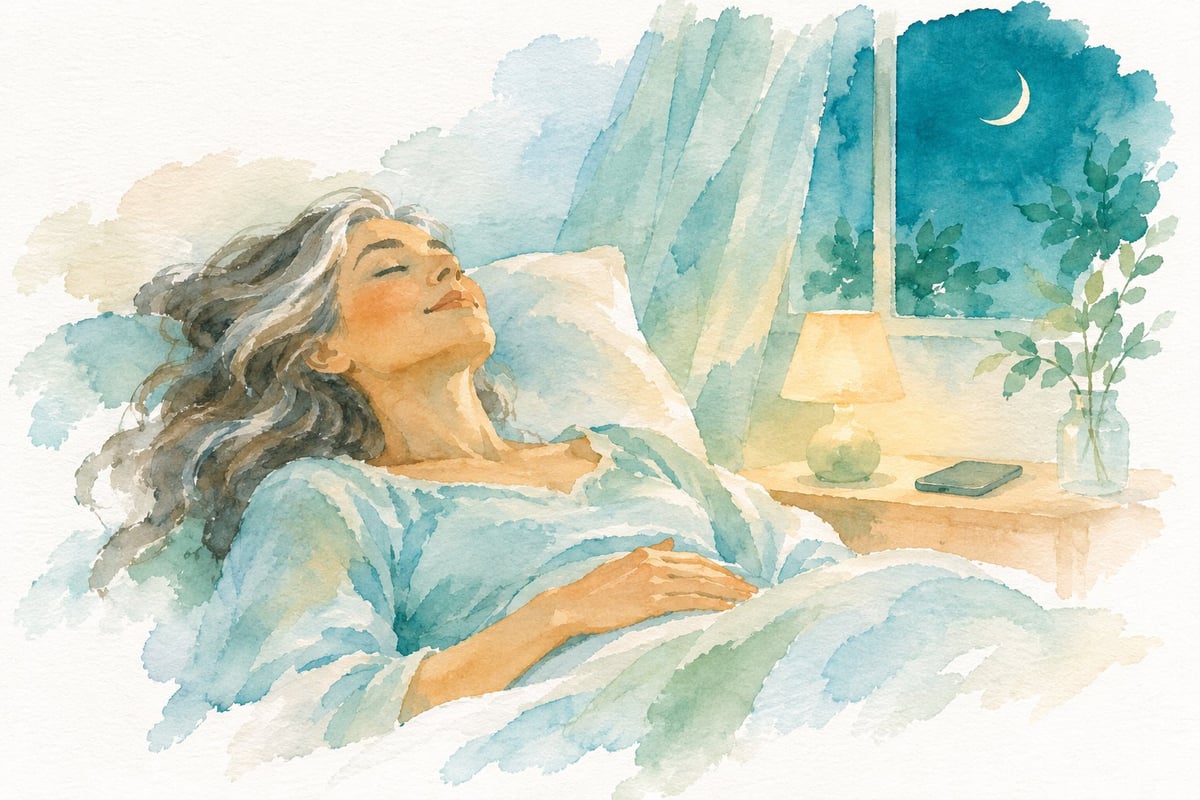
Make it part of getting into bed, every night for a month. Turn the lights off, put your phone face down, and do five minutes of slow breathing with the out-breath longer than the in-breath. Then stop counting and let your breathing do what it wants. Judge it by how you feel in the mornings after four weeks, not by one night’s sleep score.
Which pattern?
| Pattern | The counts | Why for bed |
|---|---|---|
| 4-7-8 | 4 in, hold 7, 8 out, four breaths | The out-breath is twice the in-breath. Weil’s handout suggests four breaths at a time for the first month |
| Six a minute | 5 in, 5 out, or 4 in, 6 out | No holds, so nothing to strain at when you’re tired |
| Cyclic sighing | In, a short sip, a long breath out | The best tested pattern for mood, and fine lying down |
The timer on the home page has a bedtime mode that dims the screen. Set it for five minutes and put the phone where you can’t see it.
What the studies found
In 2026, researchers pulled together nine studies of slow breathing before bed, with 457 people, all at ten breaths a minute or slower. In seven studies, people rated their sleep better, and five of those ran for 28 to 30 days. The studies that measured sleep on a wrist device or in a sleep lab didn’t find a clear change, though three of them only lasted one day.
The 2023 Stanford trial of daytime breathing found the same thing from the other side. A month of five minutes a day lifted mood, but the sleep numbers from the participants’ wrist trackers didn’t move.
Breathing before bed is like dimming the lights an hour before you sleep. It sets the stage, and the sleep still has to come on its own. A long out-breath seems to help. In a 2014 lab study, students who breathed out for longer than they breathed in felt more relaxed than when they did the reverse at the same pace.
What breathing won’t fix
If you snore loudly, wake up gasping, or someone has seen you stop breathing in your sleep, that’s a question for a doctor and a sleep study, not a breathing pattern. Taping your mouth shut isn’t the answer either. A 2025 review of 10 small, poor-quality studies found little benefit and warned of a risk of suffocation in people with a blocked nose. More on that is in mouth taping. If your watch shows low blood oxygen on those nights, oxygen.guide explains when a low night means a sleep study.
5 sources
- Eide EM, Hernes HM, Grønli J, Slow breathing techniques before bedtime and the effects on sleep: a systematic review, Sleep Medicine Reviews, 2026pubmed.ncbi.nlm.nih.gov
- Balban MY et al., Brief structured respiration practices enhance mood and reduce physiological arousal, Cell Reports Medicine, 2023pmc.ncbi.nlm.nih.gov
- Andrew Weil, 4-7-8 Breath, Andrew Weil Center for Integrative Medicine, University of Arizonaawcim.arizona.edu
- Van Diest I et al., Inhalation/exhalation ratio modulates the effect of slow breathing on heart rate variability and relaxation, Applied Psychophysiology and Biofeedback, 2014pubmed.ncbi.nlm.nih.gov
- Rhee J et al., Breaking social media fads and uncovering the safety and efficacy of mouth taping, a systematic review, PLOS One, 2025journals.plos.org